
Technical
Flexo Plate Guides
Seven short guides covering the questions we are asked most often about flexographic printing plate rubber.
Choosing a Rubber
The type of the rubber to be used is determined by:
- The ink and solvent system being used determine the base rubber:
| Water or alcohol based inks | Natural Rubber |
|---|---|
| Oil or mixed solvent inks | Nitrile |
| Inks with acetates or ketones | EP |
| For a listing of more specialized applications and solvents, consult the solvent compatibility chart or your Graphic Arts Distributor. | |
- Nature of the surface to be printed determines the hardness of the rubber:
| Film, paper, foil | Mid durometer |
|---|---|
| Corrugated, uneven surfaces | Low durometer |
| For a listing of more specialized applications and solvents, consult the solvent compatibility chart or your Graphic Arts Distributor. | |
- Type of artwork being printed also determines the hardness of the rubber:
| Box dies | Low durometer |
|---|---|
| Line work | Low to mid durometer |
| Type | Low to mid durometer |
| Fine type | Mid durometer |
| Process color work | NBR/PVC, Mid durometer |
| Offset Blanket | NBR/PVC High durometer |
| Embossing | High durometer |
- Other factors:
| Will the plate be ground to final thickness? | Easy grinding compound or a combination of face and grinding compounds. |
|---|---|
| Is any type of reinforcement being used? | Must be compatible with rubber. |
Solvent Compatibility
| SOLVENT | NR | NBR | EP |
|---|---|---|---|
| Actetates | U | U | F |
| Acetone | F | U | S |
| Alcohols | S | F | S |
| Ammonia | F | F | S |
| Aromatic Hydrocarbon | U | F | U |
| Benzene | U | U | U |
| Butyl Acetate | U | U | S |
| Butyl Cellosolve | F | F | S |
| Carbitol | F | S | S |
| Cellosolve | F | F | S |
| Cellosolve Acetate | F | U | S |
| Cottonseed Oil | U | S | F |
| Cyclohexane | U | S | U |
| Cyclohexanol | U | S | U |
| Cyclohexanone | U | U | S |
| Denatured Alcohol | F | U | S |
| Diacetone Alcohol | F | U | S |
| Dimethyl Benzene | U | F | U |
| Dowanol | U | S | S |
| Esters | U | U | F |
To be used only as a guide. When choosing a compound for printing plates, please contact your Graphic Arts Rubber Distributor. Solvent concentration, mixtures, high temperatures, and/or high nip pressure may drastically effect results.
top of the page
| SOLVENT | NR | NBR | EP |
|---|---|---|---|
| Ethyl Acetate 85% | U | U | S |
| Ethyl Alcohol | S | S | S |
| Ethyl Cellosolve | S | U | S |
| Glycerine | S | S | S |
| Glycols | S | S | S |
| Heptane | U | F | U |
| Hexane | U | S | U |
| Isopropyl Acetate | U | U | F |
| Isopropyl Alcohol | S | F | S |
| Isopropyl Ether | U | S | U |
| Kerosene | U | S | U |
| Ketones | S | U | S |
| Linseed Oil | U | S | F |
| Methyl Acetate | U | U | F |
| Methyl Alcohol | S | S | S |
| Methyl Cellosolve | F | F | F |
| Methyl Chloride | U | U | U |
| Methyl Ethyl Ketone | U | U | S |
| Methyl Isobutyl Ketone | U | U | F |
| Mineral Oil | U | S | U |
To be used only as a guide. When choosing a compound for printing plates, please contact your Graphic Arts Rubber Distributor. Solvent concentration, mixtures, high temperatures, and/or high nip pressure may drastically effect results.
top of the page
| SOLVENT | NR | NBR | EP |
|---|---|---|---|
| Mineral Spirits | U | S | U |
| Nitropropane | F | U | F |
| Normal Butyl Acetate | U | U | F |
| Normal Butyl Alcohol | S | S | S |
| Normal Propyl Acetate | U | U | S |
| Normal Propyl Alcohol | S | S | S |
| Oil | U | S | U |
| Propanol | S | S | S |
| Propyl Acetate | U | U | F |
| Polypropylene Glycol | S | S | S |
| Polyethylene Glycol | S | S | S |
| Shellac | U | S | S |
| Soy Oil | U | S | U |
| Toluene | U | F | U |
| Turpentine | U | S | U |
| V.M.& P. Naphtha | U | S | U |
| Water | S | S | S |
| Xylene | U | F | U |
| Xylol | U | F | U |
To be used only as a guide. When choosing a compound for printing plates, please contact your Graphic Arts Rubber Distributor. Solvent concentration, mixtures, high temperatures, and/or high nip pressure may drastically effect results.
top of the page
Thickness & Tolerance
The gauge of the rubber will depend on the desired thickness of the finished plate and the amount of copy that it contains.
| AMOUNT OF COPY | RUBBER THICKNESS |
|---|---|
| Average copy | +/- 10% of desired plate thickness |
| High percentage copy | 10 to 15% less than desired plate thickness |
| 100% solids | at least 20% more than desired plate thickness |
| COMMON GAUGES (inches) | TYPICAL APPLICATIONS |
|---|---|
| 0.060 | .067 plates with some solids and some copy. |
| 0.075 | .067 plates with high % of copy or for slugging. |
| 0.090 | .107 plates with low % of copy. |
| 0.100 | .107 plates with average % of copy. |
| 0.110 | .107 plates with average % of copy. |
| 0.115 | .107 plates with some solids and some copy. |
| 0.125 | .107 plates with high % solids. |
Gauge Tolerances
| SPECIFIED GAUGE (inches) | TOLERANCE (inches) |
|---|---|
| 0.020 to 0.039 | + 0.004 / - 0 |
| 0.040 to 0.060 | + 0.008 / - 0 |
| 0.061 to 0.089 | + 0.008 / - 0 |
| 0.090 to 0.115 | + 0.010 / - 0 |
| 0.116 to 0.160 | + 0.012 / - 0 |
| 0.161 to 0.200 | + 0.020 / - 0 |
| 0.201 and up | + 0.030 / - 0 |
Molding a Plate
We recommend a technique called position molding to achieve the best accuracy in the finished rubber plate. There are two key points to this technique:
The plate should be molded in the same press in which the matrix was molded.
The matrix (loaded with the rubber charge) is returned to the same position and orientation as when it was originally molded.
This will, in theory, help to minimize molded plate variation by canceling out any small inaccuracies in the cure press platens.
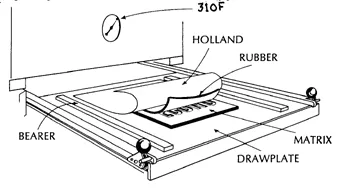
Molding Procedure
- Choose the proper combination of bearers to achieve the calculated thickness and place them in position on the lower press platen or tray.
- Cut a piece of rubber just large enough to completely cover the printing area of the matrix.
- Brush any excess uneven dust from the surface of the rubber. A light, uniform dust coating is vital to proper molding to avoid trapped air.
- Remove the protective film from the back of the rubber.
- Place the rubber with the dusted side against the room temperature matrix.
- Place the matrix/rubber charge on the lower platen tray in the proper position with the matrix side against the platen tray.
- Cover with release paper at least two inches larger than the rubber. Do not extend the release paper over top of the bearers (if it is necessary to do so, exclude the thickness of the paper from the calculation of bearer height).
- Close the press slowly until the bearers are just tight. Use only enough pressure to hold the bearers in place when lightly tapped. Excessive pressure will distort the press platens causing plate inaccuracies.
- Cure the rubber / matrix charge for ten minutes (press closed time) at 310F (60 psi Steam). We do not recommend using a preheat of the rubber.
- At the completion of the cure time, open the cure press and remove the rubber / matrix charge from the press. Carefully remove the release paper from the rubber and the rubber from the matrix to avoid tearing the rubber plate. Also avoid folding, creasing, or stretching the plate, especially while hot.
- Trim any excess flash from the rubber plate. When cooled to room temperature, the rubber plate is ready for mounting.
Bearer Thickness
Bearers are strips of accurately ground steel approximately two inches longer than the press platen. The bearers act as "stops" for the press platens, to maintain a fixed distance when curing a printing plate. A complete set of bearers should be available to the molder.
Standard thicknesses:
| Shim Steel | Ground steel |
|---|---|
| 0.002" | 0.062" |
| 0.003 | 0.125 |
| 0.005 | 0.188 |
| 0.010 | 0.250 |
| 0.015 | |
| 0.020 |
The selection of the proper thickness of bearers is essential in obtaining the desired final thickness of the finished plate. The following formula is used (values are typical and used only for example) :
| Floor of the Matrix | 0.080" (as measured -see drawing) | |
|---|---|---|
| Desired plate thickness | 0.110" | |
| Release paper thickness | + | 0.005" (as measured) |
| Bearers to be used | 0.195" |
Add bearers together to total this number, and add to each side of the cure press.
Troubleshooting
Find the symptom you're seeing, then check each possible cause listed under it.
Plate tends to stick to mold, is gummy on removal
- Cause: Rubber not fully cured.Remedy: Cure rubber for full time and temperature recommended.
- Cause: Molding press temperature too high or time in press too long (overcure).Remedy: When the heat history (time and temperature) is too high, some natural rubber stocks will revert. (cure then soften).
- Cause: Molding press temperature too low.Remedy: Raise press temperature. Also be sure press has been on long enough to reach equilibrium before starting.
Plate and/or letters not filled completely
- Cause: Insufficient charge.Remedy: Use rubber thickness within 10% of plate thickness desired except: a) Type areas 10 to 15% less than desired thickness. b) 100% solids use at least 20% more than desired thickness.
- Cause: Insufficient dust.Remedy: Redust face before molding. Store rubber in a cool dry place.
- Cause: Press closing too quickly.Remedy: Close press slowly to let air escape.
- Cause: Old or partially setup stock.Remedy: Check age of uncured rubber.
- Cause: Molding press too hot.Remedy: Check for correct and uniform temperature on platens.
Premature wear with pitting and/or swelling
- Cause: Effect of ink or cleaning solvents on incorrect rubber compound.Remedy: Use proper compound for the solvent being used.
Minute cracks in one direction on rubber surface
- Cause: Ozone exposure.Remedy: Store plates in a cool, dry, dark place in a sealed black polybag.
Plates uneven or high centers
- Cause: Mold may be overloaded.Remedy: Reduce amount of rubber.
- Cause: Platens not parallel.Remedy: Have platens adjusted.
- Cause: Old or partially setup stock.Remedy: Check age of uncured rubber.
- Cause: Rubber doesn't flow well.Remedy: Use rubber with faster flow.
Plate curls when molding or after stripping from the matrix
- Cause: Old or partially setup stock.Remedy: Check age of uncured rubber.
- Cause: Excessive molding pressure.Remedy: Use only enough pressure to ensure tight bearers. Try using less pressure to reduce initial platen pressure.
- Cause: Press closing too slowly causing rubber to partially setup.Remedy: Close press faster. Do not use preheat.
Face rubber does not adhere to backup (grinding stock)
- Cause: Rubber types are not compatible.Remedy: Select appropriate compounds.
- Cause: Old or partially setup stock.Remedy: Check age of uncured rubber.
Plate shrinks in storage
- Cause: Improper cleaning.Remedy: Use proper procedures.
- Cause: Solvent has extracted some of the plasticizer in the compound.Remedy: Use proper procedures.
Broken fabric in reinforced plate
- Cause: Old or partially setup stock.Remedy: Check age of uncured rubber.
- Cause: Compound is too stiff.Remedy: Use softer compound.
- Cause: Compound flows too much.Remedy: Use compound with less flow.
- Cause: Overloading.Remedy: Use less material.
Plate distorts and does not return to original size when stripped from matrix
- Cause: Undercure.Remedy: Press temperature too low. Cure time too short.
Face of the plate fills out but back has voids or depressions
- Cause: Insufficient rubber.Remedy: Use thicker rubber or add slugs where needed.
- Cause: Air trapped between rubber and cover sheet.Remedy: Dust back side of rubber.
Rubber tears on removal from mold
- Cause: Mold too deep for desired plate thickness.Remedy: Leave sufficient rubber in background to furnish strength required.
- Cause: Angle on text too steep or undercut.Remedy: Remake matrix or engraving.
Plate Storage
- Storage areas should be cool, dry, and away from sunlight.
- Temperature should not exceed 100°F ( 38°C), with 70°F ( 21°C) or less preferred.
- Store away from sources of ozone, such as motors, welders, corona discharge machines, and other electrical equipment.
- Plates should be cleaned immediately after use with a cleaning agent appropriate for the type of ink and the type of rubber being used. A soft cloth or soft bristled brush may be used. Excessive brushing or too stiff a brush may damage the plates.
- Cleaned and dried plates may be dusted with talc or cornstarch for long term storage.
- Do not stack plates as the weight of plates on top may distort plates at the bottom of the pile.
- Plates stored mounted on cylinders are more readily attacked by ozone. A black polyethylene wrapper should be used for protection in this case.
Need something not listed?
We mix to your specification, or design a compound around your service conditions. One call gets you to someone who can answer.